Thanks for dropping by Safe Investing South Africa. I am on a journey to build wealth my way. For any questions or comments, feel free to contact me.

28 Feb 2017

BEST SAVINGS ACCOUNT

I am obviously not coming with only one best savings account option available for South Africans. We have quite a few options to choose from. One may have to look at their personal savings goals and the time they need to save for.
Before I even begin with the main issue, I thought it would be important to note the difference between saving and investing. Savings have lower earnings with the capital being safe from any risk. Investing on the other hand usually earns higher returns, with no guarantee of preserving even the capital invested. Lets go back to the best savings account options, shall we.
Best savings account South Africa
I was reminded of the need for this post last week when my bank called to find out if I didn’t make an error by putting money in a lower interest option instead of a notice account. I must also add that, even though the banker was correct, I am not a fan of bank savings. I use the bank for my emergency fund and extremely short term savings. Bank savings usually earn one extremely low interest. The following are just a few options that one can explore:

1. Saving by Paying Debt off
I have said it before, and am saying it again, paying debt off is probably the best saving option at one’s disposal. Most debt has unreasonable interest rates which eat into whatever interest a saver earns elsewhere. Debt like credit cards and other consumer debt often cost above 20% per annum in interest. It does not make much financial sense to pay above 20% in interest whilst earning way below 10% in savings. Something for one to think about.

2. Bank Savings Accounts
South African banks have various options for cash saving. These are given various fancy names, depending on the bank’s creativity. Do not get hung up on fancy titles.

  • Basic Savings Account
This usually earns the least interest rates of the lot. I am using a one day notice account instead of this kind of account as a result. See the next bank option below for what I am personally using. A typical savings account may earn around prime interest rate minus 6.5%.  This is extremely low. It is definitely lower than inflation, which means that your money is in real terms losing value.
The main advantage of this kind of savings is that your money is readily available at all times.

  • Notice Accounts
The notice accounts also differ from bank to bank. The most popular seems to be a 32 days’ notice account. This usually earns anything in the vicinity of prime interest rates minus 5.9% from R250 to prime minus 2.9% for any savings above R50,000. You will notice that, the higher the amount saved, the higher the interest earned. You are better off with an account balance of above R50,000.
I am using a one day notice account for my emergency fund which earns from prime interest rate minus 4.75% for R5,000 to R9,999 to prime interest rate minus3.5%  for any balance above R500,000.
There are various interest rate percentages earned in between R9,999 and R50,000. There are a number of bank savings options with a similar structure. I will repeat that, these and other bank accounts are typical low interest accounts which are ideal to keep savings for short periods of time or emergencies. An example will be a contingency/ emergency fund

  • Money Market Accounts
The money market account also offers the benefit of the cash being available at any moment one needs it. The difference between the money market account and the basic account is the minimum amount one needs to keep in their account and of course the interest to be earned. This is usually from R20,000 with low earnings of about prime interest rate minus 5.75% and slightly above that for higher available savings.
Some banks offer a higher interest for their professional bankers. Wealth does pay.

  • Fixed Term Deposit Accounts
The fixed term deposit accounts have their interest varying according to the term  the money is kept in the bank. This varies from 3 months to above a year. The implications are that you will not have any access to your cash until the term chosen lapses. The interest may go up to 1.25% below prime interest rate. This is not a bad rate for savings but the inconvenience of not having the access to the cash is the main disadvantage.

  • Easy Access Deposit Accounts
Easy access deposit accounts are similar to the fixed term deposit accounts.

  • Age and other Special Benefits
Most banks give a favourable treatment to citizens above 55 years of age. If you are in this category,  investigate the extra benefits on offer for pensioners.

3. Using the Homeloan and other Tools for Savings
Given the fact that homeloans are generally costing higher interest, using them as a savings tool is beneficial. The only way to ensure that one gets their cash when they need it is to ensure that they have an access bond in place. Some people use unconventional tools like credit cards for extremely short term savings.

The key is embarking on thorough research before one decides on the best savings account that meets their needs. We have dealt with investing throughout the blog. That is the obvious way to build wealth quicker. You will always need both for building and preserving wealth.

Similar Posts
Posts on Savings
Investing in Stocks/ Shares South Africa
Investing in Savings Bonds
Exchange Traded Funds (ETFs) 

22 Sept 2015

BUYING PROPERTY FROM A SHERIFF'S AUCTION

The reader's email below is about buying property from a sheriff's auction to create wealth. All the best to you Mr S.
Student accommodation closet
Hi Mbini,
I'd like to start by thanking you for your informative blog. I have learnt so much from it.

The reason I am writing is that I would like to start investing in property and I'd appreciate getting your advice.

I have a house that I purchased 3 years ago and I am halfway through paying off the bond. I use this as my home and I would like to purchase a second house to rent out. What I would like to know is should I wait until I pay off my house (which can take up to 3 years from now) or should I borrow the money I have paid so far for my house and buy a very cheap property.

Because I don't have much money, I have been considering buying from the sheriff's auction but I have the following concerns:
1. Would I be likely to get a good property at a cheaper price
2. Do I need to purchase cash or will the sheriff's office wait for the bond approval to be processed by the bank
3. What would be the cons of buying from an auction?

Thank you for taking the time to even read this and please can I ask that you keep me anonymous should you put this on your blog.

Regards,
S
Thanks S for your email. Well done on planning to pay your homeloan so quick. I have responded to similar questions on raising funds for the investment property in my previous three posts. If you haven't already, do check those posts at:
Starting in property investing...
Paying cash for a house...
Raising capital for a property investment...
Early retirement and property investing...

If you still have specific questions on raising funds for your investment property, feel free to leave a comment below this post. Now on the sheriff's auction questions you asked:

1. Would I be likely to get a good property at a cheaper price?
Your first question is on whether you will be likely to get the good property at a cheaper price when buying property from a sheriff's auction. The short answer is that, you can get a good property at below market rate prices anywhere. Buying a bargain property is possible but because of where we are in the economic cycle, those deals are not easy to spot. Searching for bargains is not easy, especially at this time of the economic cycle. Recession is the time where opportunities to get bargains are unlimited. There is also existing players in the sheriff's auction property space. You have to go there and compete with guys who are experienced and even determined to intimidate and scare you off. Everything worth fighting for is usually a bit scary. In all, you may get the good property at a cheaper price in and outside the auction.

You will need a bit of preparation for the auction. Your local sheriff should be able to provide you with the list of what they have available. The trick with the auctions is to determine the amount of money you are willing to part with and not be easily swayed from your target. Critical decisions are not taken at the auction, but before it. You have to know how much returns on investment (ROI) you are willing to settle for. You then do the maths and know what you can offer to get those returns. Going to the auction is only to get your predetermined ROI. You may start by doing a trial exercise by going through the sheriff list, picking a property, doing the maths, attending the auction and asking the questions to have an understanding of the whole process.

A number of variables will determine your bottom line. The property you are eyeing may be having debt for water and electricity, rates and taxes, home owners association fees, and other fees you need to pay. The property may also be home to a tenant who refuses to vacate it. And getting rid of the tenant may be a costly legal battle. That is more reduction to your ROI. If the property is vacant, it may be in a bad shape or even vandalised and in need of costly repairs. Naturally, any distressed property is likely to need repairs, and that should be catered for. Renovations can be quite expensive.

2. Do I need to purchase cash or will the sheriff's office wait for the bond approval to be processed by the bank?
You need to have a deposit. But be sure you can get it back if you are unable to secure a homeloan. It is more difficult to secure a loan for a repossessed property than properties in the open market. If the property has been vacant, it is usually in a state of neglect. It may actually be in a similar state even when occupied. You stand better chances of getting the financing from the bank that repossessed that particular property if it is already in the hands of the bank. If you can, arrange for financing before hand.

3. What would be the cons of buying from an auction?
Please refer to number 1 above. Other disadvantages are related to how the property looks. You are buying it "voetstoots", meaning that you get it as is. Some of the problem areas are not easy to spot. You have no grounds to put a conditional offer. As mentioned above, you will have to pay for outstanding levies, rates and taxes and other related costs before your property is transferred to your name. I also secure the place by changing all locks before letting it to new tenants. So the security measures are not unique to distressed properties. However, it becomes even more important for properties that have been vacant for a while. Apart from those costs you have to also pay the auctioneer and sheriff's commission when buying property from a sheriff's auction. The Sheriff’s commission is about 6% on the first R30 000 of the proceeds of the sale, and 3.5% on the balance thereof. The maximum commission payable is R 10,777 plus VAT with the minimum being R542 plus VAT. The electrical compliance certificate may attract an extra cost especially if the wiring is faulty. The seller of my latest acquisition just parted with about R50,000 to fix the old wiring.

Buying property from a sheriff's auction is becoming a broad topic. I will have to follow it with a summarised version post of the sheriff's auction conditions. The bottom line is that, you may not be getting a bargain if you have not done a thorough job of investigations and calculations. The area where the property is located remains an important factor.

Note:
It is so important to never let your dream die. This evening I have been thinking about a number of doors that closed shut in my face "BANG!!!". Just as I thought, "if only I can get 1, 2, 3 opportunity, I'd be OK". Somethings blocks it. But each time I miss out on an opportunity, I somehow get amazing energy to create another one for myself. Even this blog is the direct result of writing opportunities I missed on. I always wanted to interview the South African middle class to stir a debate on how we can better our lives. I sent proposals to publications on this in vain. Until one day I decided, "Flip, I'll do it by myself". Then this blog was born. I love what I am doing here. Thanks for reading, sharing and continuing to send me emails. There are plans to grow this platform to something really big. Keep watching the space. Thanks again for being part of my happy space.

Thanks for the amazing emails. I respond to each and every email I receive. I keep all emails anonymous when I  respond to them through this platform. Feel free to make a follow up question or comment using the "Contact Us" button above.

AND If you find this post helpful, be so kind to share it on your Facebook wall or in other social networks using one of the buttons below. 

21 Sept 2015

PAYING CASH FOR A HOUSE

The reader's email below on getting a homeloan and paying it up quicker or paying cash for a house made me think a bit. All I can do is give the pros and cons of each option. I have done all three when I was trying to find my spot in the real estate space.
Kitchenette plan for the new student accommodation
Here goes our question:
Hey Mbini

Hope your are well.

I just wanted to get your take on ways in which one should pay for a house. Would you advise a new home buyer to get a home loan or pay the house cash if they have the money? And if one opts for a home loan would you advise they pay it off as quick as possible?

Thank you
I love your BLOG!!
Thanks for your question Miss P. This blog is keeping me sane on so many levels. I am currently busy with my biggest renovation so far and have limited time to write. All my free time is spent shopping for building material and drawing layman plans. I will share details of acquiring and adding value to this property hopefully soon. I find your questions much more interesting and thought provoking than my soapy mortgage and dust sniffing stories. With my current schedule I only find quiet time to write just before bed. I am very glad that more than a few people benefit from my writing. This blog is my happy space.
Back to the question at hand: Getting a mortgage and paying it up quicker versus paying cash for a house.

Option 1: Paying Cash for a House
Taking a simplistic view to this option can lead to a conclusion that it is the cheapest way as one saves on the interest that would be paid on the homeloan. The major benefit of this option could be more mental than financial. Knowing that one owns the property fully can afford them peace of mind. Peace of mind cannot be taken lightly. Let's face it, it is a nice feeling not having to pay for any monthly installment. I have enjoyed not having a homeloan each time I had none. I may never ever enjoy that ever again but it sure is a nice feeling.  I especially prefer not having a homeloan on my primary residence as its debt attracts no tax benefits.

The other advantage of paying cash is the bargaining power it affords one. It is a fact that all sellers would prefer to sell to the cash buyer. You can easily make a ridiculously low offer as a cash buyer and have it accepted. Its true that "cash is king".
Just the other week my agent got a bargain piece of development land at R1.2M asking price. Within a few days the seller got a cash offer to purchase for R800k. He immediately told my agent that he is not looking at any new offer that is not cash and will be selling to the R800k guy if he does not get a better cash offer. Sellers  don't want the stress of the buyer not being able or taking too long to secure a mortgage, changing their mind, etc. cash buyers often get better deals. These benefits make paying cash for a house seem to be the most attractive option.

Option 2: Getting a Home Loan and Paying it Faster
Option 1 does look great, however financial life is more complex than that. There is never a simple YES or NO solution  to any investment decision. There are a lot of factors involved when taking wealth building decisions. The most important of those factors being the opportunity cost. The dictionary definition of the opportunity cost is "the loss of other alternatives when one alternative is chosen". One has to consider a number of alternatives that would have been explored with that amount of cash if it were not tied to the home investment.

I will make an example of a R1M (R1,000,000) house paid for in cash. And just to be realistic for current South African interest rates, I will look at the 10% homeloan interest. If your home is paid for in cash, it is paid for and that is it. You save about another R1M in interest that you would have paid over the homeloan period of 20 years at 10% and gain some more in capital growth of your home. You also save a bit in interest if you get a mortgage and fast track its payment.

Lets now look at the case where the same R1,000,000 (R1M) would have been saved in a bank account (investment) or bond that earns 10% in interest. Remember that those are more secured, which makes our calculation a bit more realistic compared to using a higher risk and higher return investment. Over the 20 years period your R1M would turn to just above R7,328,000 (R7.3M). You and I know that you can do better if you use a stocks related investment vehicle. (I am not going to complicate this equation by factoring in the alternative shelter variable, sorry.)

The only difference here is that with your home paid for in cash, your money is tied into one illiquid asset. Whilst saving or investing your R1M in one or more other more liquid asset classes may offer more risk combating benefits.

Option 3: Deposit a Few Properties
Ok, I had to throw in this third option. It is the approach that I would personally take based on my own focus strategy. Paying cash for a house is something I have done a few times in my early days by the way. Whilst it gives this priceless feeling, not taking advantage of the power of leverage does not sit well with most property investors. I would take the R1,000,000 and get into serious real estate debt. It would probably be my 20% equity to acquire R5,000,000 worth of investment property. Using it as a 10% equity to a R10,000,000 (R10M) worth of investment property sounds even better. Oh well, that is just me. This approach carries tons of risks. But those risks are shared with the lending institution.

I will revisit blogging on building wealth through "the power of LEVERAGE". My latest acquisition with no deposit or down payment is a great example of this.

One needs to do a lot of research before investing their hard earned cash. If one has no clear focus strategy, they should invest in education, a mentor or a coach. In the previous post  on Building Wealth I was looking at a simple three phase approach on creating and growing wealth.

 Note:
Thanks for the amazing emails. I respond to each and every email I receive. I keep all emails anonymous when I  respond to them through this platform. Feel free to make a follow up question or comment using the "Contact Us" button above.

If you find this post helpful, be so kind to share it on your Facebook wall or in other social networks using one of the buttons below. 

16 Sept 2015

BUILDING WEALTH

A steady and sustainable way of building wealth begins with a focus strategy. That’s the gist of the message that I have for the reader who sent me an email below recently. Thanks CV for your email.
Here we go:
Hi to the recipient of this email,

Your blog that I just read is very inspiring. Pardon my poor English firstly. I would like to tell you my story.

I am a varsity dropout and started working a year ago. I just turned 21 a month ago and I am earning steady income currently of R10 000. I am living with my parents and my current work circumstances is about to change as I am working in the engineering industry which I also started my studies in but
did not finish. My parents are on the verge of bankruptcy. I do not want to fall into the same "rat race" as described in "rich dad, poor dad".
I have built a reasonably good credit record so far. I haven't made any permanent debt except for a cellphone contract. I am an entrepreneur at heart and I am very interested in letting the little amount of money I have work for me. What would you recommend I do?

I feel exactly as described by your blog. I want to LIVE. I do not want to
work to live.

I hope to hear from you soon and to learn as much as possible.

Kind regards,
C V
As I already mentioned in my introduction above CV, building wealth starts by drawing a focus strategy. Most people fail to recognise the power of being intentional and deliberate in the way they lead their lives. Luck may cut it but taking conscious steps stands a better chance. You are obviously on the right track because you already know where you don’t want to be. And that is in the “rat race”. But do you know where you want to go? You mentioned entrepreneurship and having your money work for you. Those are both causes worth fighting for. For you to reach where you want to go you will need to take the three steps listed below:

Earn Enough

Building wealth starts with earning and earning enough. We all know that any amount saved is better than nothing saved at all. What beats saving any amount is saving more than just any amount. One can only save more when they earn more. And one can earn more when they empower themselves. If you love your current job, get yourself skilled in doing it better to attract better opportunities. One needs to be proactive to get themselves where they want to be.

If you think of a way to earn even more than your salary, explore those options. Side hustles are always a great way of fast tracking growing wealth. Explore your passions, talent and skills and try to monetise those. Opportunities do present themselves when we are busy working on bettering ourselves.

I will not waste your time explaining how you need to take charge of our expenses. You seem to be mastering that one already. Staying with your parents for as long as possible could be one way of cutting costs. It is only when we spend less than we earn that we stretch our rand.

Save More
After having earned enough for building wealth, save at an escalated rate. This is where most people miss it. They earn a high income and spend it all and then some. High income exposes one to higher credit, which can translate to higher debt. The fact that you qualify for higher credit to buy a bigger house, car or whatever luxury does not mean you should go out and buy those. Wise people live below their means.

I have written a few articles on paying yourself first. Draw a budget to determine how much you need for each month. What helps in drawing a more accurate budget is tracking your spending for a few months. In that few month keep the receipts for all your expenses and have them recorded in the spreadsheet. I actually swipe my card and do electronic transfers everywhere possible for my spending to ensure that I have everything on record. I cannot be trusted with keeping small pieces of paper.

Using the monthly records of how much you are spending, draw up a budget. In your budgeting start with shelter, transportation, food and all the basic needs (your must haves). Add a small amount of wants to your budget (your good to have). Cut out wants that are unnecessary like the gym membership and the pay TV. Those are always my favourite victims. Hopefully you can cover all what is in your brand new budget with 60% (R6000) of your income or less. That leaves you with 40% (R4000) or more of your income for saving and investing.

Make a thorough research on interest earned by bank accounts like a money market accounts. Open the highest interest bearing transacting account of your choice at the bank. (Mine earns 5.6% and requires a minimum of R5000 to open and keep). This bank account will keep your short term savings. Some refer to this account as an emergency or contingency fund. Name it whatever you wish, just open and use it.

The purpose of this account is to handle emergencies. Some people prefer to keep 3, 6 or 12 months’ worth of monthly expenditure in their emergency accounts. If you go for 3 months, you will not need R10,000X3 (R30,000) but R6000X3 (R18,000) if we make assumptions based on our example on budgeting above. This has to do with what you need to go through the month and not what you earn. I take this to be the most crucial step at creating, preserving and building wealth. Even at these low interest rates, you are benefiting from the compound interest. See this article on the magic of compound interest.

Invest Even More
Still on building wealth and taking it a step further by investing. Think about LIVING well, attaining financial freedom when you can still enjoy your life and retiring when you want to. I would say that before you even start with different forms of investing, get yourself a good retirement annuity to take advantage of the tax benefits.

Read my recent articles on tax free savings here, here and here and see what vehicle you can use for your long term savings/ investments. I am a fan of exchange traded funds as a passive form of stock investing. You will need to do your own research to see what works for you. Keep empowering yourself on what is available on the market. At your age, you can build a lot of wealth from very little. You have 19 years to 40 and 14 years to 35, if you decide to retire then. Your investment decisions can be planned around the amount of time you have before your planned retirement.

Other asset classes that you may invest in include property, bonds, stocks, etc. Your investment asset has to earn you capital growth and create passive income for you over time. Re-balance your portfolio from time to time as you are continuously building your wealth. A diversified portfolio is generally lower risk.

In conclusion, my own formula with creating, growing and building wealth is in three small stages. Those are earning enough, saving more and investing even more. Thanks for your question again CV. Please read the article I wrote for my sister who was starting out in this link: Building Wealth from First Job.

Note:
Thanks for the amazing emails. I may take longer, but I respond to each and every email I receive. I keep all emails anonymous when I do respond to them through this platform. Feel free to make a follow up question or comment using the "Contact Us" button above.

If you find this post helpful, be so kind to share it on your Facebook wall or in other social networks using one of the buttons below. 

5 Aug 2015

EARLY RETIREMENT AND PROPERTY INVESTING

The combination of early retirement and property investing is the reason this blog exists. I am a part time personal finance coach with passion for property investing. My plan has always been property investing for financial freedom and early retirement.  Any other investing that I do is meant to balance my portfolio out and manage the risk. This is why it thrilled me to receive the email from one reader below:

Hey Mbini
I just stumbled upon your blog while doing some research on emergency funds, and I must say I found a Gem. I am very interested in early retirement and property investing and this is the first South African blog I have found on both subjects, most blogs I follow are either from the USA or Europe and sometimes it’s difficult for me to follow some of their advice as it doesn’t pertain to South Africa. So thanks for the blog it will help immensely in my own early retirement and property investing journey.
Kind Regards
Early Retirement and Property Investing
Thanks reader for your email. Emails like this one are humbling. I have benefited from sharing what I know on wealth building here more than anyone can imagine. Having someone else gain value from the blog blesses me.

Like most, I am a product of a "go to school; get good grades; get a job; work hard; retire comfortably at 65" generation. In case you haven't noticed "Living" is not part of that equation. I did follow that common “wisdom” by going to school and getting good grades. I was quite a competitive learner. I was never fond of books but I had a way to make it. And so I found myself being a graduate and moving towards the next goal of getting a job so I can work hard and retire just before death.

This is where I had a problem. I needed life before retirement. I doubt if anyone wants to work hard just to retire and die. Yet, everyone seemed to expect a successful life to follow this "logical" sequence. I was desperate to add “live” before and after the job in my own life equation. I needed to live because having a business as a student meant less living. Working hard until retirement was never an option.  And so my own formula became:
[go to school; get good grades; live; get a job; live; retire; live]
50 percent of my life was to be more about living than anything else. Living requires some level of preparedness. It is about working towards doing what you want to do. Living is about searching for your passion and pursuing it wholeheartedly. Working until 65 sounded... very wrong to me. I am neither a careerist nor a specialist. Throughout my life I have invested in a lot of unrelated studies and businesses. I have to be constantly excited about something new.

And so in my 20s, just after investing in my first apartment, I stumbled upon a book “Rich Dad, Poor Dad”. And like the Buddhist Proverb states, “When the student is ready, the teacher will appear”; that was what I needed. At that point I had gone from selling candy in primary school to paying my way through university selling soft furnishings manufactured by myself and trying my luck at MLM after graduating to supplement my low income. I was more than determined to fit in the "live" variable in my life equation and do so in my own terms. That is how a property investor within me was born.

I immersed myself in investment related reading material until I understood the basics well enough to start implementing. After getting married to a like-minded guy, we joined forces to pursue the “early retirement and property investing” dream. This does not feel anything like work. I am enjoying every single minute of it, including sharing it here in this post right now. It has become part of me that I get irritable when I am not inhaling dust doing quality control in a construction site.

We initially bought tiny homes to let and slowly changed our investment strategy to bigger homes in high demand upmarket suburbs and are gradually getting into commercial property. Whats more exciting is that I get invites to talk to small groups of young professionals and couples on living debt free, savings, growing wealth, early retirement and property investing. And, yeah, I write here too. And guess what… I am living. This passion keeps me alive.

Just remember that this is a business. And like any other business one needs a proper strategy and a good plan to execute it. For a very long time I heavily relied on my property manager to keep everything together. Building systems helps any business to run itself. One will always need people who know and do just about anything that needs to be done. And that enables one to “live”.

I am glad that I chose to “live”.

Note:
Thanks for the amazing emails. I keep all emails anonymous when I do respond to them through this platform. Feel free to make a follow up question or comment using the "Contact Us" button above.

If you find this post helpful, be so kind to share it on your Facebook wall or in other social networks using one of the buttons below. 

4 Aug 2015

LOW COST TAX-FREE INVESTMENT

My previous post on the Tax-Free savings account looked at the investor who has the R30,000 R33,000 per year. This excludes a whole lot of people who are still busy fighting debt or afford less. Its only fair to go through a different low cost tax-free investment exercise. Reading this post together with the previous one may be beneficial as some of the information given in that post helps clarify this tax benefit better. You may also look at the other post on tax free savings and the one on Exchange Traded Funds (ETFs).

The most effortless way to invest in shares is through ETFs in my opinion. This should be a great option for those who lack the time and resources to invest in individual company and industry research. Losing money in the stocks, especially when you do not have a well-informed strategy is quite easy. The stress that goes with speculation can be outsourced to ''experts'' who are well trained to read the markets. A hands-on approach is also not a bad idea for inquisitive minds like mine. It is important to remember that, only a few of us can manage to be jacks of all trades with success. Definitely not me. That is the reason I strive for a diversified portfolio, with some loyalty to property investing. Real estate is my passion and what I have chosen to pursue. I am well pleased with the fact that it remains my main source of income. But that is not the point of this post.

Our low cost tax-free investment exercise will be on a R500 per month amount. To spice the exercise a bit, I am throwing in R3000 extra from the investor's annual bonus. I have such an overactive imagination, I know. Our investment qualifies to be referred to as low cost because ETFs are generally relatively cheap investments.

Remember that you can invest your monthly R500 in one ETF, a combination of two ETFs or even a combination that includes any other two qualifying products. National Treasury mentioned the collective investment schemes, bank savings accounts, fixed deposits, retail savings bonds, REITs, etc, as qualifying products. Let us quickly list our assumptions:
  • Similarly to our previous example, I am using 25% annual return. (Again this is attainable).
  • Monthly Investment of R500
  • Every year, the investor adds a R3,000 into the fund from their annual bonus
  • Return per annum 25%
  • Term in years 16 (I am using the same number of years from our previous exercise for consistency’s sake. More years at this amount make better investment sense.)
  • Tax Rate 0%
  • All income like dividends earned is re-invested
  • There are no withdrawals throughout the investment period
Year Beginning of Year Interest End of Year Contribution
Year 1R3,500R1,720.12R10,720.12R9,000
Year 2R14,220.12R4,729.59R24,449.71R18,000
Year 3R27,949.71R8,583.92R42,033.63R27,000
Year 4R45,533.63R13,520.30R64,553.92R36,000
Year 5R68,053.92R19,842.44R93,396.36R45,000
Year 6R96,896.36R27,939.41R130,335.79R54,000
Year 7R133,835.79R38,309.48R177,645.27R63,000
Year 8R181,145.27R51,590.75R238,236.02R72,000
Year 9R241,736.02R68,600.49R315,836.51R81,000
Year 10R319,336.51R90,385.39R415,221.91R90,000
Year 11R418,721.91R118,286.03R542,507.92R99,000
Year 12R546,007.92R154,019.21R705,527.13R108,000
Year 13R709,027.13R199,783.86R914,310.99R117,000
Year 14R917,810.99R258,396.06R1,181,707.05R126,000
Year 15R1,185,207.05R333,462.57R1,524,169.64R135,000
Year 16R1,527,669.64R429,602.64R1,962,772.27R144,000
Results
  • Total Amount Invested is R144,000 ((R500 X 12)+(3000))X16
  • End of Term Balance is R1,962,772.27
  • Total Interest (income) earned R1,818,772.27
It does look impossible to turn R500 per month into almost R2 Million, but if this particular fund continues performing as well as it currently does, this outcome is a possibility. As mentioned in the previous post, this government incentive means no income tax, no dividends withholding tax and no capital gains tax.

Once again, please do:
  1. Ensure that your investment product of choice does qualify to be one of the tax free savings accounts. Most exchange traded funds (ETFs) qualify.
  2. Note that our exercise is on a 16 year term, however one can go on until they reach the allowed maximum contribution of R500,000 in their lifetime (at the moment: August 2015) whilst avoiding to exceed R30,000 (increased to R33,000 in 2017) in any one year.
  3. Note that withdrawals cannot be re-invested and still count as part of the lifetime limit.
  4. Report to SARS in the section under income earned in the tax free account and declare your income as non-taxable.

Note:
Thanks for the amazing emails. I keep all emails anonymous when I do respond to them through this platform. Feel free to make a follow up question or comment using the "Contact Us" button above.

If you find this post helpful, be so kind to share it on your Facebook wall or in other social networks using one of the buttons below.

2 Aug 2015

CHOOSING ETFS FOR MY TAX FREE SAVINGS ACCOUNT

If you have been following this blog for a while, you will probably have guessed that I will be choosing ETFs for my tax free savings account. I’m quite predictable, I know hey. I have a bit of an obsession with the Exchange Traded Funds and have written about them quite a bit in this blog especially when I was giving investing advise to teenagers, to those in their 20s and general information to those who email me questions. The ETFs remain the best choice for those who prefer to take a less hands on approach to equities investing.

There are a number of ways that one can use to take advantage of the new tax free savings. I cannot have been the only one who patiently waited to see if the exchange traded funds will be suited to the tax free savings account. How delighted I was to read that all institutions that have a banking or collective investment scheme license will be eligible to offer products through this tax free savings or investment account. This benefit is actually even extended to stockbrokers that are registered with the Financial Services Board (FSB) and the Johannesburg Stock Exchange (JSE). In all, almost all certified financial service providers can easily offer products that exploit this great benefit.

Most will agree that R30,000 R33,000 per year (maximum) is quite a lot of money to be saved in a low performing savings account. Ag, any amount of money should be invested where it attracts a decent amount of interest. I definitely think my R33,000 would be better off invested in the ETF or a combination of ETFs than in most savings accounts that are in existence. That's the reason that I am choosing ETFs for my tax free savings account.

Below is a little exercise to see how one can potentially gain in the ETF investment with this generous tax benefit.
NB: the exercise is based on the initial tax free account annual allowance of R30,000. This has been increased to R33,000 from March 2017.

Assumptions: 
  • I am using 25% return. (The ETF that my son is currently using averaged 27.67% per year over 5 years and around 30% during my son's investment period).
  • Annual Investment at the beginning of each year R30,000
  • Return per annum 25% 
  • Term in years 16 
  • Tax Rate 0% 
  •  All income like dividends earned is re-invested
  • No withdrawals throughout the investment period
Year Contribution Beginning of Year Interest End of Year
Year 1 R30,000.00 R30,000.00 R7,500.00 R37,500.00
Year 2 R60,000.00 R67,500.00 R16,875.00 R84,375.00
Year 3 R90,000.00 R114,375.00 R28,593.74 R142,968.75
Year 4 R120,000.00 R172,968.75 R43,242.19 R216,210.94
Year 5 R150,000.00 R246,210.94 R61,552.73 R307,763.67
Year 6 R180,000.00 R337,763.67 R84,440.94 R422,204.59
Year 7 R210,000.00 R452,204.59 R113,051.15 R565,255.74
Year 8 R240,000.00 R595,255.74 R148,813.93 R744,069.67
Year 9 R270,000.00 R774,069.67 R193,517.41 R967,587.09
Year 10 R300,000.00 R997,587.09 R249,396.75 R1,246,983.86
Year 11 R330,000.00 R1,276,983.86 R319,245.97 R1,596,229.83
Year 12 R360,000.00 R1,626,229.83 R406,557.47 R2,032,787.28
Year 13 R390,000.00 R2,062,787.28 R515,696.81 R2,578,484.11
Year 14 R420,000.00 R2,608,484.11 R652,121.02 R3,260,605.13
Year 15 R450,000.00 R3,290,605.13 R822,651.28 R4,113,256.41
Year 16 R480,000.00 R4,143,256.41 R1,035,814.10 R5,179,070.52
Results
  • Total Amount Invested R480,000.00  (R30,000 X 16)
  • End of Term Balance R5,179,070.52 
  • Total Interest (income) earned R4,699,070.52
Choosing ETFs for my tax free savings account
I know, this looks a bit far-fetched. Well it may be a bit optimistic but it is possible to turn R480,000 to R5 Million in less than two decades (keeping all other things equal). Even more awesome is the fact that dividends and capital gains will attract no income tax, no dividends withholding tax and definitely no capital gains tax.

Important to Note:
  1. Double check with the financial service provider that your investment product of choice qualifies to be one of the tax free savings accounts. Typical accounts that qualify include the collective investment schemes, bank savings accounts, fixed deposits, retail savings bonds, REITs, etc. 
  2. National Treasury did confirm that most exchange traded funds (ETFs) do qualify. However, direct share purchases do not qualify.
  3. Exceeding the yearly contribution of R33,000 (current limit in 2017) will attract the tax on the amount above the limit. The R33,000 yearly and R500,000 lifetime contribution may be reviewed and adjusted based on affordability conditions and inflation. 
  4. Withdrawals are discouraged and cannot be re-invested. This results in the tax benefit being forfeited.
  5. Both your service provider and yourself will be required to do annual reporting through SARS annual returns in the section under the income earned in the tax free account and declared as non-taxable income.  
Note:
It has been a hectic few months. Exciting times ahead. I will be renovating a multi-family property soon. I will let you in on the ups and downs of acquiring this property.

If you find this post helpful, be so kind to share it on your Facebook wall or other social networks using one of the buttons below.

18 May 2015

RAISING CAPITAL FOR AN INVESTMENT

Today only, I have discussed the subject of raising capital for an investment or business with four or five different individuals and groups. Because of the nature of my passion, I meet a lot of "I don't know where to start" kind of people, and the "I know what I want but have no means" sorts. I now realise that my well packaged "start where you are" response falls short, as an overwhelming majority of us doesn't really know where they actually are. Sources of capital will be broken down shortly.

Firstly, I have to briefly let you know where I had hibernated to. I missed this blog, the lessons it gives to me and the amount of sanity it affords. If you think you are learning anything from this space, you most likely have no idea how much more I learn from you. Thanks for your support.
Townhouse Renovation/ Refurbishment
Whilst I was away, I renovated an existing unit to raise the rental to an amount higher than an average asking rental in the complex and it worked. Most of my April was spent on that. Then on getting great education on managing own investment property and putting structures in place. An exciting book on retirement and real estate was sent to me for a review. And I also worked on raising capital to finance my latest acquisition which will also be sort of a commercial property. I have more than ten articles in my head on all that. The first of which is raising capital for an investment.
Landscaping a Garden of a Rental Unit
Own Savings
I know this sounds impossible, but I do have a close friend who is a debt free investor. She owes no one nothing. She has a beautiful story from nothing to being a multimillionaire (dollar multimillionaire) and that from her own small cash. With enough patience and good investment education, one can build up a sizable amount of cash and start small with flipping. Small profits build up into bigger and eventually mega profits. A few very special investors get this one right. Part of which I am not.

Taking from what you already have
An access bond facility is an amazing asset to have. If you can, request this facility on your new or existing home loan from your financial service provider. This facility acts as a separate investment or savings account and allows you to access the additional amounts paid into your mortgage. The excess amount that you pay into your homeloan over and above your monthly installment is made available to you. I know people who actually save money in their home loan by paying extra lump sum amounts or monthly additional deposits to raise money to further invest or buy a car, etc. Before you make any extra payment on your bond, make sure that you have the access bond facility in place.

A similar way of raising funds is from refinancing an existing asset. This is what I had to do with two properties for a new acquisition. I applied for what is known as a re-advance. The readvance is in most cases the difference between your current mortgage debt and the initial home loan amount. If you owe R300,000 from an initially registered amount of R1M, you may be approved for a readvance of R700,000. In my case, the advantage was the interest rates. the original homeloans were very cheap. The new homeloans from the readvance automatically get the same interest rates as the original bonds.

Of the two options, I would choose the access bond facility as a tool for raising capital for an investment or business. A readvance approval is never guaranteed as it follows the process of a new home loan application. It all depends on your credit rating.

Issuing of Private Shares
Another form of raising capital for an investment is through forming partnerships. When you have a solid investment project idea and not enough funds, it is worth approaching a few private lenders to go into partnership with you. You need to keep the control of the company in mind whilst valuing your shares fairly. Since control is important to you, you may want to get more than 50 percent shareholding to be able to take important decisions in the business independently. You may then sell the remaining 49 percent or less to raise the capital needed to finance the investment.

Issuing shares is not only beneficial in raising the capital, but also as a form of risk sharing. If you keep 51 percent of the shares, you are only facing the same amount of risk from the project. Similarly, your investor(s) are standing to lose 49 percent should things go south. For that same reason it takes a good proposal to get an investor to buy into your idea. You need to prepare a detailed proposal with a clear section on returns on investment. Investors buy returns and nothing else.

If all goes well, you may, at a later stage buy your partners out and go solo. This off course is usually easy as seasoned investors want in and out of the deal as soon as possible. When the returns are great, they will sell to you and move on to the next deal.

Traditional Form of raising Funds
This is how most of us are raising capital for an investment or business. We go to the bank. Well, if it works, there's absolutely nothing wrong with a good old bank home-loan application.

Let me just alert you to the mistakes I have made in this area of my investment life.
  • I got a bond originator and trusted them to know absolutely everything. Even stuff I never told them about myself. The truth is that, you need to strip your wealth life naked for your bank to finance your investment.
  • I filled as few the papers as possible. I am grateful for the technology of scanning and emailing. My application takes the shape of a thousand paged bible. Even the tiny income I make from writing is added in my income folder. All rental contracts and every piece of evidence that I can and do get income from wherever is filed, and added to the nice income spreadsheet and sent to the bank. That and evidence that I own some assets.
  • I took whatever interest rate I was offered as long as it was below prime rate. The interest rate you are quoted initially is negotiable. I now believe that they start with an interest rate much higher than what you deserve to allow some space for negotiations. Adopt a principle of negotiating a rate until you get that satisfying feeling that says you have reached the absolute minimum. With my latest acquisition I got quotes from two banks; I took the lowest rate quote to the higher rate bank; and then that bank's reduced rate to the first bank until I knew I reached the bare minimum.
  • I panicked about the time the transaction is taking. Doing a thorough job securing appropriately priced funding is way better than having the transaction wrapped in a short time.
  • I played myself down like I am not a big or important enough investor. When you recognise your value as an investor, you get respect back from lenders. You are a valuable enough investor to the bank or any lender. Down playing yourself is not going to take you far enough. You are all that. Go get them!

Thanks for hanging around. I will take time to respond to your emails. If you find this article valuable, CLICK below to share on Facebook and other networking platforms.

30 Mar 2015

PREPARING A PROPERTY FOR RENTAL

I will never exhaust the topic of preparing a property for rental but I can always share a project of my own. This is my latest property renovation which is now tenanted, thanks God. This is a 4 bedroom, now 3 bathroom family home with servants quarters that house their new full bath.
Apologies in advance for the possible slower loading of this post due to the number images.
Rental Property Kitchen
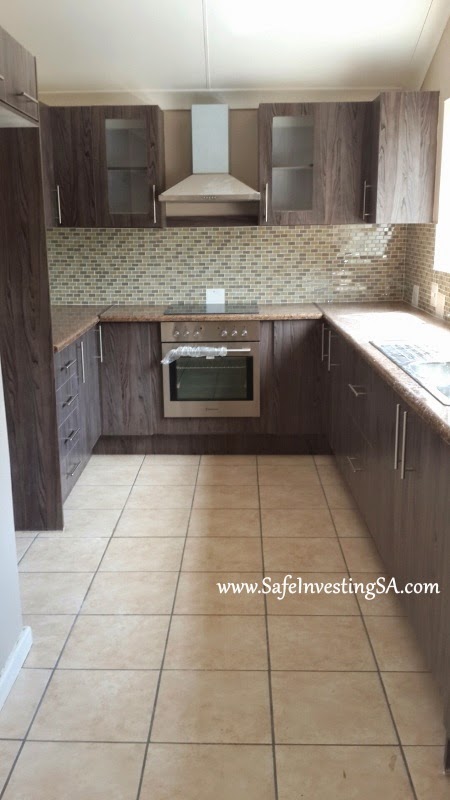
I never took the picture of this kitchen in a good light day. The wall tile is the nice shiny glass mosaic one. A good tile can make or break the kitchen. Rather use the tile minimally and buy a great looking one. Most people's choice to rent of buy a property is influenced by how the kitchen looks.
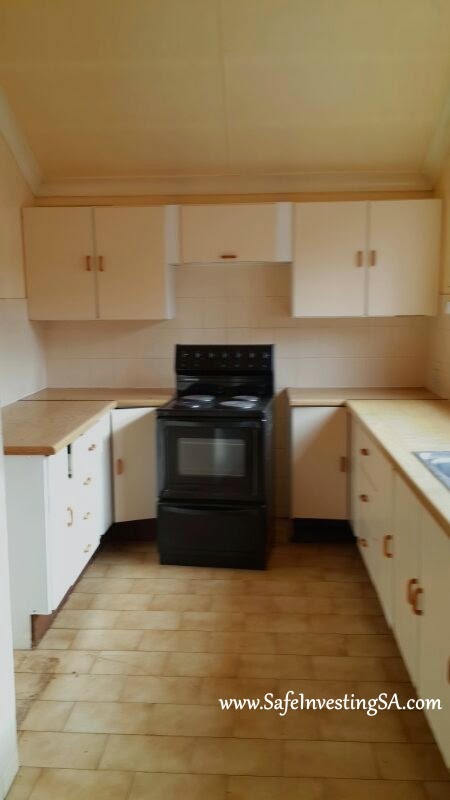
Below is how our kitchen looked when we bought the place. We followed the layout of the original kitchen to save costs on plumbing and electric wiring. Besides, a kitchen this narrow is not easily maneuverable.
Preparing a Property for Rental
Nothing was good enough to be reused in the old kitchen. This is a typical galley kitchen; quite narrow but long enough to give a lot of storage space. There is a separate laundry area on the other side too. It is so worth it cleaning up the kitchen and bathrooms. You don't only get a tenant quicker, but increase the probability of getting a higher quality one too. The more the applicants, the better the chance, right!
Bathroom of a Rental Property - before
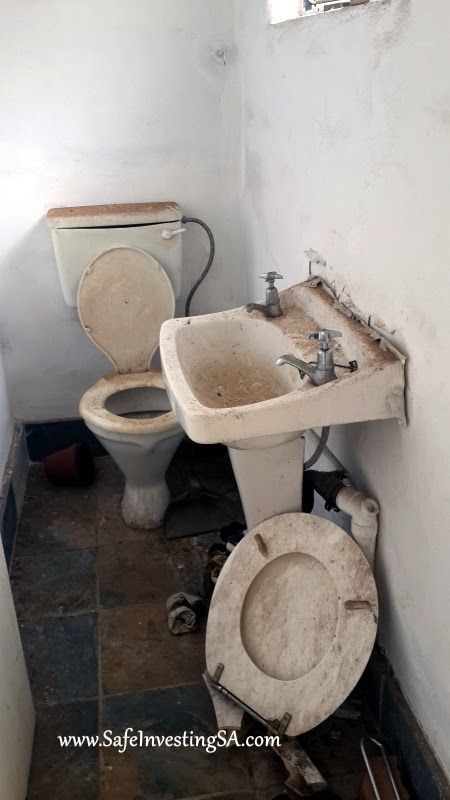
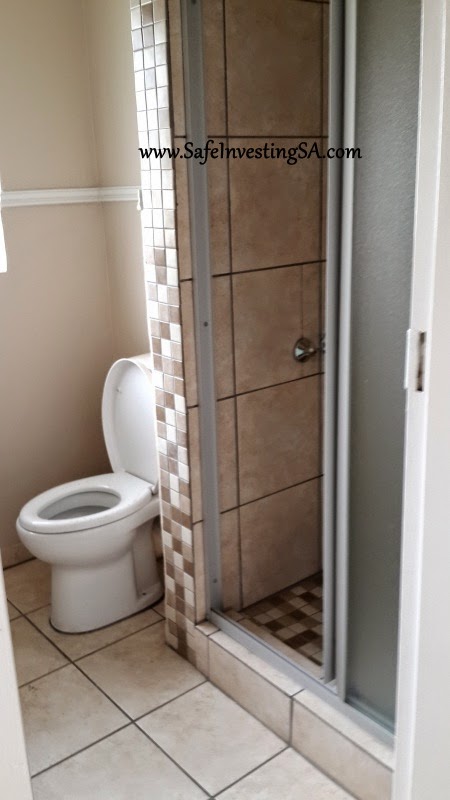
I could not add more photos of this room than necessary, but this was a guest toilet without a hand basin. We added a corner basin as space in this bathroom is an issue. That took it to an ideal 3 full bathroom house. And South Africans do love their bathrooms in numbers. Two bathrooms are viewed as minimum but throwing in a half makes your property more marketable. Modern houses usually have the equal number of or more bathrooms than bedrooms. OBSESSION!
Bathroom Remodel Project
This is definitely not a fancy job. I sniffed loads of dust in this process. Remember I am hardly ever on site when this happens but I still feel it. Replacing tiles, basins and toilets with better looking and modern ones increases the marketability of your property.
Cleaning the Bathroom up for Rental
Always remember to go towards neutral colours. Can you spot a white dado rail disguising an uneven wall but also serving as a nice trim? It is far cheaper than re-plastering the wall. You need not break the bank when preparing a property for rental. A can of paint will always up the value of your property.
Recycle when Remodelling
 I personally spray painted my old wooden curtain rails to reuse in this project. I would have used a nicer looking rust-oleum if the dark stain one was in stock. These had to be left to dry outdoors overnight. Did I mention how much I saved by reusing these old rods? I also used existing metal rails. I still wish I painted those in black.
Now to the really scruffy part of the project.
Fitting a Shower in a Small bathroom -before
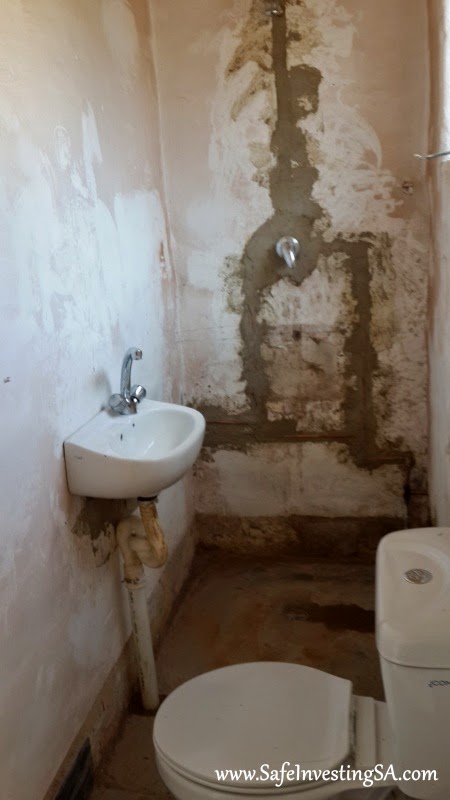
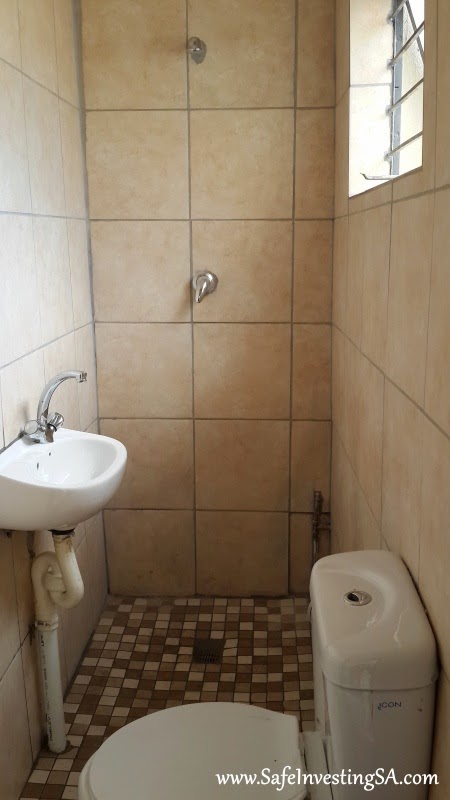
Yes, this is the "before" of an outdoor toilet in the Servant's Quarters. The tenants in this area insist on a fully usable SQ bathroom. And as we all know, what the tenant wants, the tenant gets. I had a number of hand drawn ways to fit a shower in this tiny one metre wide toilet. At the end, I had to have the basin inside the shower.
Preparing a Property for Rental - shower fitting
 Exciting to see that everything is fitting nicely. I bought the smallest of everything. That basin is the tiniest. We couldn't even get a mixer that fits in the middle. Did you notice that the mixer is on one side of the basin?
Adding a Shower in a Tiny Bathroom
Space this small is better off tilled from floor to ceiling and on all walls. This addition was made a little expensive by the fact that water drainage pipes did not exist anywhere close to the space. We had to drill and add pipes inside and outside the room.
I never took the "AFTER" photos as this room was completed the day the tenant moved in. In my defense, they moved in a few days earlier.  And finally...
Securing a Rental Property
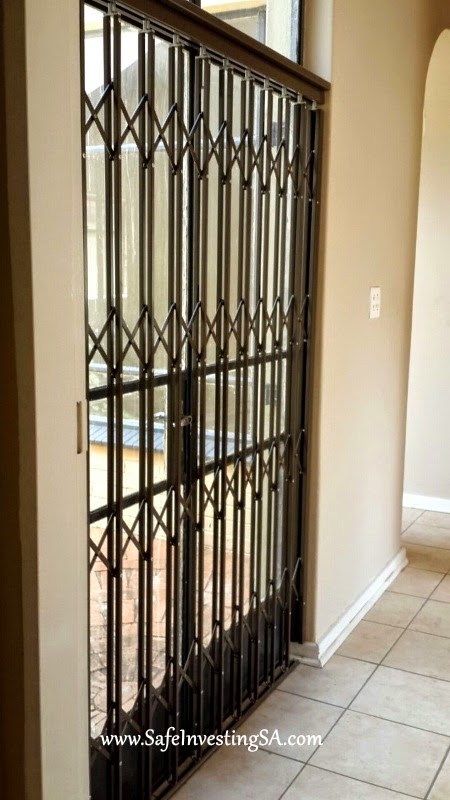
 Sadly, the cost of security is what we cannot escape. This house is made of glass doors. All bedrooms and living areas facing the swimming pool open up to it. I loved these vintage doors but they cried "restore me". Trellis are also not a bad option as they completely slide open during the day. That's how I go about preparing a property for rental. Now to the business side of things.

Why We Bought this Property
  1. This property is in a street that is fast becoming a business street. Across the street are mainly offices, doctors' rooms, a garage, and the like. It is also in close proximity to restaurants and a shopping complex. What is even more awesome is that it is a walking distance from my home. We have plans to turn it into a commercial property in a year or two.  
  2. I know I am a location freak but this was an additional strength. There is a reasonable demand for property of this nature in this suburb. Most of the house viewers were corporate clients for their expatriate families.
  3. Family homes like this one have to be very close to schools and most recently in Gauteng, Gautrain stations. A number of people commute between Pretoria and Johannesburg daily. This house gets a tick on each of those.
  4. I am sort of transitioning to this kind of market specialisation. The plan is to limit the scope to semi or fully furnished corporate homes. This will further limit the quantity of properties I manage (when I start self managing) but hopefully increase the quality and returns. 
  5. The price was right. When I first saw the listing which only showed the back of the property, I called my agent to investigate who the owner was and get the property for me. This was done in a day. It was quite cool to get interest from buyers after the clean up, but we are not property flippers.
I enjoyed this project but it took longer than planned to complete. I am already craving something new to work on. I tend to feel idle in between projects. The life of a serial renovator can be exhausting but definitely exciting. What do you think of my minor renovation?

NOTE:
If you find this post helpful, be so kind to share it on your Facebook wall or other social networking platforms using one of the buttons below.

23 Mar 2015

TRADING IN STOCKS

A lot of us want to start investing in the stock exchange like the Johannesburg Stock Exchange (JSE) but are held back by fear. The thought can be quite overwhelming. No surprise there though; a whole lot of things look scary from the outside. Let us try to unpack the basics of trading in stocks, equities, shares or whatever else you prefer to refer to it as.
Trading in Stocks
I know, I'm back with examples that most educated people find undermining or patronising. Reason being that I am explaining to the reader who is like me when I started out. I was really that bad, and worse. This is what stock trading does and does not look like:

  1. You start a restaurant that specialises in chicken meals. You need capital, some skills, time and the practical know how. The returns on your investment will be referred to as profits. This is a real brick and mortar physical business and obviously not any form of trading in stocks. 
  2. The alternative is to buy the shares of an existing popular chicken restaurant, which makes you an owner or shareholder of a piece of that restaurant. You may be owning a tiny fraction of the percentage but who cares. Your concern is whether your fraction is growing, stagnant or shrinking. You also have a responsibility of reading and following the progress of the restaurant. When it does really well, part of the profits are shared among the shareholders including yourself. This share of profits that you get is referred to as a dividend. Dividends can be an amazing way of diversifying one's income. The higher the number of your shares, the higher your dividends. Also important to state is that, in an event that the company goes bankrupt, your loses are only on what you have invested and never on the assets that you own outside of your stocks. And this is trading in stocks or equities.

Companies that are publicly listed in the stock exchange do so to raise funds that are used in growing and in the running of those companies. Whilst as a shareholder you become a part owner of a particular company, dividends and share growth are never guaranteed. There is an element of risk, especially in the short term of the share ownership. In the longer term the performance of one's shares are more likely to yield higher returns. Pointing you to the name of this blog; safe investing is never a rushed process. It requires a lot of patience.

If you have been with me for a while you may have stumbled on the post on balancing your portfolio. Trading in stocks can can be one of the building blocks of a balanced portfolio. The main advantage of trading in equities is in owning a number of businesses without owning any of them. English can be fascinating, don't you think? Whilst shareholders don't wake up to go to the business they have invested in daily, share trading is not passive in any way. A more passive kind of investing in shares could be an investment through the Exchange Traded Funds (ETFs). Even that cannot be classified as passive because an investor is expected to make some effort in getting a deeper understanding of what is happening in the market. With share trading one needs to follow the company news and the economic or finance news daily. Markets can go crazy in a matter of days or hours. Despair not though, you will love following news when you start trading.

I would not see trading in stocks as a "get-rich-quick" scheme. It is possible to get lucky and make a lot of money or lose it in a short space of time. I so hope that your main goal is making some money constantly without a rush of a gambler. Like most investment vehicles, equities require some patience. One has to save and keep liquid money at hand to buy at the time they see as perfect. The timing is usually determined by the price changes. We buy at low rising prices and sell at high prices.

The trading happens at such a huge scale that it is easy to be ignorant to the fact that there is a willing buyer and willing seller setting the price on the market. The most popular form of trading is done electronically, of course. The stock price that one sees is the one determined primarily by the willingness of the millions of buyers and sellers to act, which is also referred to as demand and supply. A number of events in economies influence this demand and supply. As Economics101 states, high demand will lead to higher prices whilst the high supply reduces the stock prices. This is what is the basis for your trading decision making.

Before taking a decision to invest in a particular stock, you look into the ins and outs of that particular company. What the company does; how it operates; who runs the company; how profitable it is; how much it grew in the past; how is the competition; what is its strategy; etc. When a company gets some sort of negative reports like their product usage getting reduced because of competition, its demand will shrink and so will its share price. This is one of the reasons that the stock traders read and listen to business news. In reality they get paid for following business news. An investor cannot afford to be lazy to hunt for and consume information. And luckily for our generation, information is readily available in print, audio and on visual media. One does not even need to hire an expensive full-service brokerage to manage their trading activities. A lot of companies, including banks, offer cheaper DIY trading platforms.

The Bulls vs the Bears:

You have probably heard of the bull and the bear markets. A bear market is when a lot of the economic indicators are looking bad. This is like the recession market. During the bear market, one needs to time the buying and the selling to make some profits.
The bull market on the other hand is when the economy is looking good. It is an easier time for trading in stocks. An investor needs to have a strategy to deal with all kinds of markets. In the long run, markets have a way of evening the loses and gains out.

Research:
  • Trading in stock involves brokerage fees which can be costly. Compare the costs and commissions of available trading platforms. I personally use one of the banks which I found not to have high costs.
  • Nothing takes the place of thorough research and staying informed. Know your economy well enough to be able to pre-empt its changes. You have to know where you are going and how you plan to get there. You also need to look at the trends for a specific target sector and each target stock within the sector.
  • If in doubt, start with the Exchange Traded Funds (ETFs) where a broker takes a whole lot of responsibility from you. You may take that time to learn the trading ropes from forums, books and some websites.
  • Learn about the risks. And YES, it is possible to lose everything you have invested. It may not be likely if you are not trying hard to beat the market, but it is a possibility. Remember that this is not the gamble, its an investment. Starting with good quality growing companies could be a much better strategy. Whilst small caps can be lucrative, they carry a bit more risk.

Note:
I have been away for more than a month. After traveling for a few weeks I came back to my last renovation project. I was exhausted to the point that my doctor ordered me to get rest. As soon as my tenant got settled, I gave myself almost a full month rest from writing. I don't like that, but it was necessary.

If you find this post helpful, be so kind to share it on your Facebook wall or other social networks using one of the buttons below.